

WHATSAPP/Tel:+86 18561958384

E-mail: export@jointeflon.com

NEWS

location:

PTFE Tube

2026-04-08 JOINTEFLON

As industries demand reliable fluid handling in extreme conditions, PTFE (Polytetrafluoroethylene) tube stands out as a high-performance solution, dominating sectors from aerospace to medical technology. Renowned for its unrivaled chemical inertness and temperature resilience, this "king of plastics" delivers unmatched value in mission-critical applications, outperforming traditional and alternative materials alike.
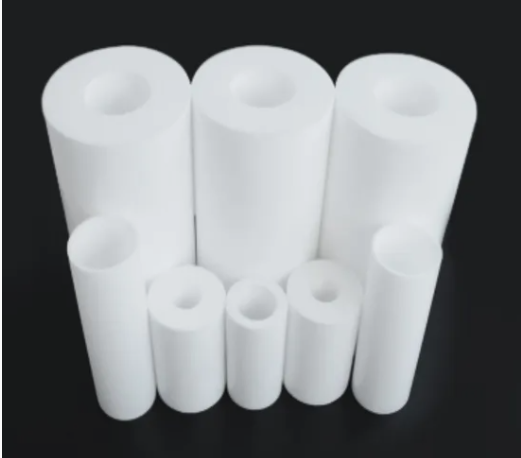

As industries demand reliable fluid handling in extreme conditions, PTFE (Polytetrafluoroethylene) tube stands out as a high-performance solution, dominating sectors from aerospace to medical technology. Renowned for its unrivaled chemical inertness and temperature resilience, this "king of plastics" delivers unmatched value in mission-critical applications, outperforming traditional and alternative materials alike. PTFE tube’s core strengths set it apart: operating from -75°C to 260°C , it withstands extreme thermal shifts that crack rubber tubes (EPDM/FKM) below -40°C or degrade them above 150°C . Its chemical resistance is unparalleled—resisting king acid, hydrofluoric acid, and 500ppm chloride solutions—while rubber swells 5-10% in glycol-based fluids and 304/316L stainless steel succumbs to pitting . With a friction coefficient as low as 0.04 , it minimizes flow resistance and fouling, cutting pump energy use by 15-20% compared to rubber or unpolished stainless steel . Metal-braided variants reach 36MPa burst pressure , bridging the gap between flexible rubber (<5MPa) and rigid stainless steel. Key applications span high-stakes industries: aerospace wire harnesses and engine compartments benefit from its lightweight durability ; semiconductor fabs use it for ultra-pure etching fluid transfer ; medical devices leverage its USP Class VI biocompatibility for sterilizable catheters ; and AI data centers adopt it for immersion cooling, thanks to its UL 94 V-0 flame rating and 2.1 dielectric constant that eliminates short-circuit risks . It also meets FDA 21 CFR 177.1550 standards for food processing, preventing product adsorption . Versus alternatives, PTFE delivers superior longevity: its 10+ year lifespan triples that of FKM rubber . While FEP/PFA tubes offer better flexibility or transparency , PTFE excels in extreme heat and corrosion resistance. Though costlier upfront than rubber (3-5x higher), its low maintenance and replacement costs drive long-term value. “PTFE’s unique blend of inertness, temperature stability, and safety makes it irreplaceable in high-risk environments,” notes a Parker Industries engineer . As industries push for efficiency and reliability, PTFE tube remains the gold standard for critical fluid transfer.


PTFE tube’s core strengths set it apart: operating from -75°C to 260°C , it withstands extreme thermal shifts that crack rubber tubes (EPDM/FKM) below -40°C or degrade them above 150°C . Its chemical resistance is unparalleled—resisting king acid, hydrofluoric acid, and 500ppm chloride solutions—while rubber swells 5-10% in glycol-based fluids and 304/316L stainless steel succumbs to pitting . With a friction coefficient as low as 0.04 , it minimizes flow resistance and fouling, cutting pump energy use by 15-20% compared to rubber or unpolished stainless steel . Metal-braided variants reach 36MPa burst pressure , bridging the gap between flexible rubber (<5MPa) and rigid stainless steel.

Key applications span high-stakes industries: aerospace wire harnesses and engine compartments benefit from its lightweight durability ; semiconductor fabs use it for ultra-pure etching fluid transfer ; medical devices leverage its USP Class VI biocompatibility for sterilizable catheters ; and AI data centers adopt it for immersion cooling, thanks to its UL 94 V-0 flame rating and 2.1 dielectric constant that eliminates short-circuit risks . It also meets FDA 21 CFR 177.1550 standards for food processing, preventing product adsorption .

Versus alternatives, PTFE delivers superior longevity: its 10+ year lifespan triples that of FKM rubber . While FEP/PFA tubes offer better flexibility or transparency , PTFE excels in extreme heat and corrosion resistance. Though costlier upfront than rubber (3-5x higher), its low maintenance and replacement costs drive long-term value. “PTFE’s unique blend of inertness, temperature stability, and safety makes it irreplaceable in high-risk environments,” notes a Parker Industries engineer . As industries push for efficiency and reliability, PTFE tube remains the gold standard for critical fluid transfer.